
Monday to Saturday from 09:00 a.m. to 8:00 p.m
Sunday no service. h.We will also attend your consultations through our Social networks profiles


Maybe your question has a quick answer, look it up in our finder of frequently asked questions.
Yes. Eurochange is fully licensed to sell foreign currency. You can buy your foreign currency at some of our money exchange offices or through our website.
Yes, you can bring your currency and we will exchange it into Euros. But remember we just can accept notes, not coins.
Yes. According to current legislation, it is mandatory to present an original and valid (not expired) identity document. We accept Passports or National ID cards (for EU citizens). Remember, if you are a member of the Eurochange Club, the process is faster, but your documentation must be up to date in our system.
We have Eurochange exchange offices in the main tourist resorts of Alicante, Murcia, Almeria, Málaga and Mallorca. You can check our locations here.
Get to know our opening hours and exact addresses of each office by visiting each area, for example, do you want to know where we are located in Benidorm? Click here
No. Eurochange has two kind of licences: one to buy currency and one to sell curreny. We can buy currency at all our branches, that is, you can exchange your currency to Euros. However, we just can sell foreign currency at some of our branches or through our website. Check our buy and sell service page to see the branches where you can buy foreign currency.
In Eurochange we work with more than 40 different currencies and we are constanley expanding. You can consult our list of currencies for which we currently have available.
If you need to buy or sell a currency that is not on the list, please contact us and we will confirm the availability.
You can come to any our Eurochange exchange offices with the notes and we will confirm whether they are legal tender or no longer in circulation. You can also send a photo by e-mail or by WhatsApp and we will confirm if they are still valid.
No, in Eurochange we only work with foreign banknotes. We can't accept coins of other currencies. Remember to spend or exchange all coins before your return home.
In Eurochange we update our rates daily of all our currencies. If you want to know the rate you can consult our rates. If you have any questions you can call us and we'll be glad to help.
No, in Eurochange we do not apply commissions. The amount you will receive is directly calculated using the daily exchange rate.
Yes, in Eurochange we offer better rates than the banks and offices at the airports. Also we do not charge commissions. If you're not sure you can compare us, our rates are transparent.
Yes, in all Eurochange branches will find the same exchange rate updatd daily (but in special promotions that can be set for any branch). You can consult it at any office or on our website.
Yes, we have the same rates for all currencies on our website and in our money exchange offices.
Choose the currency you want ant the amount in our conversor. You can also place a reservation by e-mail at [email protected] calling us at (0034) 615 403 877 or sending us a WhatsApp message to the same number.
It is not mandatory but is strongly recommended that you make a reservation to ensure we have the amount you want available for the chosen date. If you want to check the availability of any currency you can do so by calling (0034) 615 403 877.
The price applied is the rate of the day of collection. If you want to keep the rate of the day you should choose the option BUY (when available). This way you will pay your currency at the moment and you will be able to go to collect at the time that best suits you in any of our exchange offices of collection or to choose the home delivery option and you will receive your order within 24-72 hours depending on the stock.
Depending on the stock of currencies we have each day, we can cater reservations even for that same day. However, it is best to reserve your currency in advance, at least 2 or 3 days in advance.
Yes, there is no time limit to reserve your currency. If you're traveling in a few weeks and don’t want to worry about the issue, we have no objection at all.
Yes. You can make changes on it by sending us an email to [email protected] or by calling (0034) 615 403 877. To the extent possible, we will make the changes you ask us.
Yes. If you signed up into the site, you can go to your private area and cancel the reservation. If you made the registration without registering, you can cancel it by sending us an email to [email protected] or by calling (0034) 615 403 877.
At Eurochange you can buy foreign currency online to be delivered at home or to be collected in one of our branches with currency delivery service. You must register online, choose the currency and amount and make the payment. You will recieve you currency between the following 24 -72 hours.
Use our converter to choose the currency you need and the quantity. Select the BUY option and complete the steps of the purchase process. You will have to register if you are not yet a customer. Go ahead and pay by entering your card details. Once the payment is confirmed, simply complete your customer profile, choose your preferred delivery date and time, and your currency will be available within 24–72 working hours.
Modifications or cancellations of orders must be communicated by phone at (0034) 615 403 877 during our customer service hours, modifications will be made as much as possible as long as the order has not been processed. In that case, no order can be changed or canceled once it has been processed.
According to the law against money laundering, currency exchange transactions should be identified with the ID. For this reason we ask you to provide us with a readable file with both sides of your ID. It will be only necessary that you send it for the first time for when you make your purchase, then it will be stored on our system.
If you want to make any changes on your personal details, delivery address, etc., you can do so on your private area which you will access with your ID number and password. You can also do so by contacting us at [email protected] or (0034) 615 403 877. If you want to cancel your online account, you must contact us.
If you want to receive the latest news in your inbox, please fill out the form on the left side of our BLOG to register for our newsletter.
Yes, in your private area you can see a list of all the orders you've made, both online or in our branches.
When you buy currency on our website, you can pay with your credit / debit card or by bank transfer to the account number that we will provide. If you choose the option to pay by transfer, remember that your order may be delayed until we confirm that the transfer has gone through correctly.
In all our exchange offices you can pay in cash (remember that we can only accept notes, not coins). Furthermore, in some of our exchange offices you can pay with credit / debit card* Visa, Master Card or Maestro. Visit our card payment service to see where this service is available.
* When you buy Euros you will pay an administration fee of the 2% of the total. Buying foreign currency with any kind of card is free of charge.
This service is available in Spain (penninsula), Balearic Islands, Ceuta and Melilla. Not available Canary Islands.
As a general rule, you will receive your purchased currencies in 24 hours at the address you have given us. In exceptional cases, due to lack of stock, delivery may be delayed no longer than 72 hours after the payment is received. Anyway, you will see the delivery time on the order confirmation view before paying.
The shipping cost is calculated automatically in the shopping cart based on your postal code. We offer very competitive rates starting from €4.99, for the Peninsula. Remember, if your exchange amount exceeds a certain limit (check current promotions), shipping might be completely FREE! In-store collection is always free of charge.
Yes, you can access to your private area and check the status of all your orders.
Yes, depending on the order that you made (from other currency to Euro or from Euro to other currency) there will be some of our branches available to be chosen.
To become a member of our club just go to the nearest Eurochange exchange office with your ID, you will be asked to give us you e-mail address and a contact telephone number and you will receive your card at that very moment.
In addition from benefiting from promotions for members only, you will accumulate points to receive better exchange rates on your transactions. moreover you won't have to bring your ID to exchange money. Your card will be enough.
If you register on our website, in your private area you will see a list of all operations that have generated points and check out the points balance. The system is updated automatically, but it may take a few minutes to see your last exchange on the list. Contact us if you don't see the exchange listed after 30 minutes.
If you have not registered on the website, you can go to the nearest office or contact us and we will tell your points balance.
Yes. With our Buy Back service you will be able to return up to the 30% of the money you bought with the same rate you paid. Remember that the original purchase must be over 750 Euros to take advantage of this service.
At Eurochange, we are very strict about the quality of cash to ensure our customers receive banknotes in perfect condition. We exchange what banks don't accept, We exchange all currencies all over the world, obsolete bank notes, exotic bank notes and old bank notes, even broken bank notes. If you have doubts about the condition of your notes, you can send us a photo beforehand or visit a branch for our team to assess them.
Yes. To comply with Anti-Money Laundering regulations, there are certain thresholds. For large amounts (generally over €3,000 or €6,000 depending on the transaction), we may ask for additional documentation to prove the source of funds (payslip, professional activity, etc.). For standard tourist transactions, a valid Passport/ID is sufficient up to the established legal limit.
Yes, in those branches equipped with a card payment terminal (POS), we accept contactless payments via mobile devices such as smartphones or smartwatches, provided they are linked to an accepted card (Visa or MasterCard).
Sometimes you might need specific banknotes. For example, in some Asian or South American countries, it’s recommended to carry US dollars in perfect condition and from certain years of issue. If you have any special requests regarding the banknotes you need, please contact us and explain your requirements. We’ll do our best to prepare your order accordingly.
Eurochange shipments are delivered to the address provided. If you’re not home, the courier will leave a notice or send an SMS to arrange a new delivery. You can also request that the package be sent to the nearest courier office so you can pick it up yourself.
There’s no one-size-fits-all answer. In cities like New York, cards are widely accepted, but in places like Vietnam, cash is often essential. We recommend carrying at least part of your budget in cash—you’ll know exactly what you’re spending and avoid hidden bank fees. Use your card as a backup, and always check your bank’s exchange rates and commission policies before you travel.
For security reasons, home deliveries are only made to the person who placed the order. If you authorize someone else during checkout, the package will be addressed to that person and only they can receive it. If you need to authorize multiple recipients or add special delivery instructions, please contact us.
Yes, thanks to our partnership with Western Union, you can send money to over 200 countries or receive it within minutes securely at our branches. You only need your valid ID and the recipient's details.
Yes, we manage Tax Free cheque cashing. We work with major operators (such as Planet, Global Blue, etc.) so you can claim your tax refund before leaving the EU. Please check with your nearest branch for service availability.
Sure! It's the fastest way. Message us at (+34) 615 403 877 indicating the currency you need, the amount, and the branch where you want to collect it. We will confirm availability instantly.
Yes. Eurochange is fully licensed to sell foreign currency. You can buy your foreign currency at some of our money exchange offices or through our website.
Yes, you can bring your currency and we will exchange it into Euros. But remember we just can accept notes, not coins.
Yes. According to current legislation, it is mandatory to present an original and valid (not expired) identity document. We accept Passports or National ID cards (for EU citizens). Remember, if you are a member of the Eurochange Club, the process is faster, but your documentation must be up to date in our system.
We have Eurochange exchange offices in the main tourist resorts of Alicante, Murcia, Almeria, Málaga and Mallorca. You can check our locations here.
Get to know our opening hours and exact addresses of each office by visiting each area, for example, do you want to know where we are located in Benidorm? Click here
No. Eurochange has two kind of licences: one to buy currency and one to sell curreny. We can buy currency at all our branches, that is, you can exchange your currency to Euros. However, we just can sell foreign currency at some of our branches or through our website. Check our buy and sell service page to see the branches where you can buy foreign currency.
In Eurochange we work with more than 40 different currencies and we are constanley expanding. You can consult our list of currencies for which we currently have available.
If you need to buy or sell a currency that is not on the list, please contact us and we will confirm the availability.
You can come to any our Eurochange exchange offices with the notes and we will confirm whether they are legal tender or no longer in circulation. You can also send a photo by e-mail or by WhatsApp and we will confirm if they are still valid.
No, in Eurochange we only work with foreign banknotes. We can't accept coins of other currencies. Remember to spend or exchange all coins before your return home.
In Eurochange we update our rates daily of all our currencies. If you want to know the rate you can consult our rates. If you have any questions you can call us and we'll be glad to help.
No, in Eurochange we do not apply commissions. The amount you will receive is directly calculated using the daily exchange rate.
Yes, in Eurochange we offer better rates than the banks and offices at the airports. Also we do not charge commissions. If you're not sure you can compare us, our rates are transparent.
Yes, in all Eurochange branches will find the same exchange rate updatd daily (but in special promotions that can be set for any branch). You can consult it at any office or on our website.
Yes, we have the same rates for all currencies on our website and in our money exchange offices.
Choose the currency you want ant the amount in our conversor. You can also place a reservation by e-mail at [email protected] calling us at (0034) 615 403 877 or sending us a WhatsApp message to the same number.
It is not mandatory but is strongly recommended that you make a reservation to ensure we have the amount you want available for the chosen date. If you want to check the availability of any currency you can do so by calling (0034) 615 403 877.
The price applied is the rate of the day of collection. If you want to keep the rate of the day you should choose the option BUY (when available). This way you will pay your currency at the moment and you will be able to go to collect at the time that best suits you in any of our exchange offices of collection or to choose the home delivery option and you will receive your order within 24-72 hours depending on the stock.
Depending on the stock of currencies we have each day, we can cater reservations even for that same day. However, it is best to reserve your currency in advance, at least 2 or 3 days in advance.
Yes, there is no time limit to reserve your currency. If you're traveling in a few weeks and don’t want to worry about the issue, we have no objection at all.
Yes. You can make changes on it by sending us an email to [email protected] or by calling (0034) 615 403 877. To the extent possible, we will make the changes you ask us.
Yes. If you signed up into the site, you can go to your private area and cancel the reservation. If you made the registration without registering, you can cancel it by sending us an email to [email protected] or by calling (0034) 615 403 877.
At Eurochange you can buy foreign currency online to be delivered at home or to be collected in one of our branches with currency delivery service. You must register online, choose the currency and amount and make the payment. You will recieve you currency between the following 24 -72 hours.
Use our converter to choose the currency you need and the quantity. Select the BUY option and complete the steps of the purchase process. You will have to register if you are not yet a customer. Go ahead and pay by entering your card details. Once the payment is confirmed, simply complete your customer profile, choose your preferred delivery date and time, and your currency will be available within 24–72 working hours.
Modifications or cancellations of orders must be communicated by phone at (0034) 615 403 877 during our customer service hours, modifications will be made as much as possible as long as the order has not been processed. In that case, no order can be changed or canceled once it has been processed.
According to the law against money laundering, currency exchange transactions should be identified with the ID. For this reason we ask you to provide us with a readable file with both sides of your ID. It will be only necessary that you send it for the first time for when you make your purchase, then it will be stored on our system.
If you want to make any changes on your personal details, delivery address, etc., you can do so on your private area which you will access with your ID number and password. You can also do so by contacting us at [email protected] or (0034) 615 403 877. If you want to cancel your online account, you must contact us.
If you want to receive the latest news in your inbox, please fill out the form on the left side of our BLOG to register for our newsletter.
Yes, in your private area you can see a list of all the orders you've made, both online or in our branches.
When you buy currency on our website, you can pay with your credit / debit card or by bank transfer to the account number that we will provide. If you choose the option to pay by transfer, remember that your order may be delayed until we confirm that the transfer has gone through correctly.
In all our exchange offices you can pay in cash (remember that we can only accept notes, not coins). Furthermore, in some of our exchange offices you can pay with credit / debit card* Visa, Master Card or Maestro. Visit our card payment service to see where this service is available.
* When you buy Euros you will pay an administration fee of the 2% of the total. Buying foreign currency with any kind of card is free of charge.
This service is available in Spain (penninsula), Balearic Islands, Ceuta and Melilla. Not available Canary Islands.
As a general rule, you will receive your purchased currencies in 24 hours at the address you have given us. In exceptional cases, due to lack of stock, delivery may be delayed no longer than 72 hours after the payment is received. Anyway, you will see the delivery time on the order confirmation view before paying.
The shipping cost is calculated automatically in the shopping cart based on your postal code. We offer very competitive rates starting from €4.99, for the Peninsula. Remember, if your exchange amount exceeds a certain limit (check current promotions), shipping might be completely FREE! In-store collection is always free of charge.
Yes, you can access to your private area and check the status of all your orders.
Yes, depending on the order that you made (from other currency to Euro or from Euro to other currency) there will be some of our branches available to be chosen.
To become a member of our club just go to the nearest Eurochange exchange office with your ID, you will be asked to give us you e-mail address and a contact telephone number and you will receive your card at that very moment.
In addition from benefiting from promotions for members only, you will accumulate points to receive better exchange rates on your transactions. moreover you won't have to bring your ID to exchange money. Your card will be enough.
If you register on our website, in your private area you will see a list of all operations that have generated points and check out the points balance. The system is updated automatically, but it may take a few minutes to see your last exchange on the list. Contact us if you don't see the exchange listed after 30 minutes.
If you have not registered on the website, you can go to the nearest office or contact us and we will tell your points balance.
Yes. With our Buy Back service you will be able to return up to the 30% of the money you bought with the same rate you paid. Remember that the original purchase must be over 750 Euros to take advantage of this service.
At Eurochange, we are very strict about the quality of cash to ensure our customers receive banknotes in perfect condition. We exchange what banks don't accept, We exchange all currencies all over the world, obsolete bank notes, exotic bank notes and old bank notes, even broken bank notes. If you have doubts about the condition of your notes, you can send us a photo beforehand or visit a branch for our team to assess them.
Yes. To comply with Anti-Money Laundering regulations, there are certain thresholds. For large amounts (generally over €3,000 or €6,000 depending on the transaction), we may ask for additional documentation to prove the source of funds (payslip, professional activity, etc.). For standard tourist transactions, a valid Passport/ID is sufficient up to the established legal limit.
Yes, in those branches equipped with a card payment terminal (POS), we accept contactless payments via mobile devices such as smartphones or smartwatches, provided they are linked to an accepted card (Visa or MasterCard).
Sometimes you might need specific banknotes. For example, in some Asian or South American countries, it’s recommended to carry US dollars in perfect condition and from certain years of issue. If you have any special requests regarding the banknotes you need, please contact us and explain your requirements. We’ll do our best to prepare your order accordingly.
Eurochange shipments are delivered to the address provided. If you’re not home, the courier will leave a notice or send an SMS to arrange a new delivery. You can also request that the package be sent to the nearest courier office so you can pick it up yourself.
There’s no one-size-fits-all answer. In cities like New York, cards are widely accepted, but in places like Vietnam, cash is often essential. We recommend carrying at least part of your budget in cash—you’ll know exactly what you’re spending and avoid hidden bank fees. Use your card as a backup, and always check your bank’s exchange rates and commission policies before you travel.
For security reasons, home deliveries are only made to the person who placed the order. If you authorize someone else during checkout, the package will be addressed to that person and only they can receive it. If you need to authorize multiple recipients or add special delivery instructions, please contact us.
Yes, thanks to our partnership with Western Union, you can send money to over 200 countries or receive it within minutes securely at our branches. You only need your valid ID and the recipient's details.
Yes, we manage Tax Free cheque cashing. We work with major operators (such as Planet, Global Blue, etc.) so you can claim your tax refund before leaving the EU. Please check with your nearest branch for service availability.
Sure! It's the fastest way. Message us at (+34) 615 403 877 indicating the currency you need, the amount, and the branch where you want to collect it. We will confirm availability instantly.
Yes. According to current legislation, it is mandatory to present an original and valid (not expired) identity document. We accept Passports or National ID cards (for EU citizens). Remember, if you are a member of the Eurochange Club, the process is faster, but your documentation must be up to date in our system.
No. Eurochange has two kind of licences: one to buy currency and one to sell curreny. We can buy currency at all our branches, that is, you can exchange your currency to Euros. However, we just can sell foreign currency at some of our branches or through our website. Check our buy and sell service page to see the branches where you can buy foreign currency.
In Eurochange we work with more than 40 different currencies and we are constanley expanding. You can consult our list of currencies for which we currently have available.
Yes, in Eurochange we offer better rates than the banks and offices at the airports. Also we do not charge commissions. If you're not sure you can compare us, our rates are transparent.
It is not mandatory but is strongly recommended that you make a reservation to ensure we have the amount you want available for the chosen date. If you want to check the availability of any currency you can do so by calling (0034) 615 403 877.
At Eurochange you can buy foreign currency online to be delivered at home or to be collected in one of our branches with currency delivery service. You must register online, choose the currency and amount and make the payment. You will recieve you currency between the following 24 -72 hours.
According to the law against money laundering, currency exchange transactions should be identified with the ID. For this reason we ask you to provide us with a readable file with both sides of your ID. It will be only necessary that you send it for the first time for when you make your purchase, then it will be stored on our system.
When you buy currency on our website, you can pay with your credit / debit card or by bank transfer to the account number that we will provide. If you choose the option to pay by transfer, remember that your order may be delayed until we confirm that the transfer has gone through correctly.
The shipping cost is calculated automatically in the shopping cart based on your postal code. We offer very competitive rates starting from €4.99, for the Peninsula. Remember, if your exchange amount exceeds a certain limit (check current promotions), shipping might be completely FREE! In-store collection is always free of charge.
In addition from benefiting from promotions for members only, you will accumulate points to receive better exchange rates on your transactions. moreover you won't have to bring your ID to exchange money. Your card will be enough.
At Eurochange, we are very strict about the quality of cash to ensure our customers receive banknotes in perfect condition. We exchange what banks don't accept, We exchange all currencies all over the world, obsolete bank notes, exotic bank notes and old bank notes, even broken bank notes. If you have doubts about the condition of your notes, you can send us a photo beforehand or visit a branch for our team to assess them.
Yes, in those branches equipped with a card payment terminal (POS), we accept contactless payments via mobile devices such as smartphones or smartwatches, provided they are linked to an accepted card (Visa or MasterCard).
There’s no one-size-fits-all answer. In cities like New York, cards are widely accepted, but in places like Vietnam, cash is often essential. We recommend carrying at least part of your budget in cash—you’ll know exactly what you’re spending and avoid hidden bank fees. Use your card as a backup, and always check your bank’s exchange rates and commission policies before you travel.
Yes, thanks to our partnership with Western Union, you can send money to over 200 countries or receive it within minutes securely at our branches. You only need your valid ID and the recipient's details.
Sure! It's the fastest way. Message us at (+34) 615 403 877 indicating the currency you need, the amount, and the branch where you want to collect it. We will confirm availability instantly.
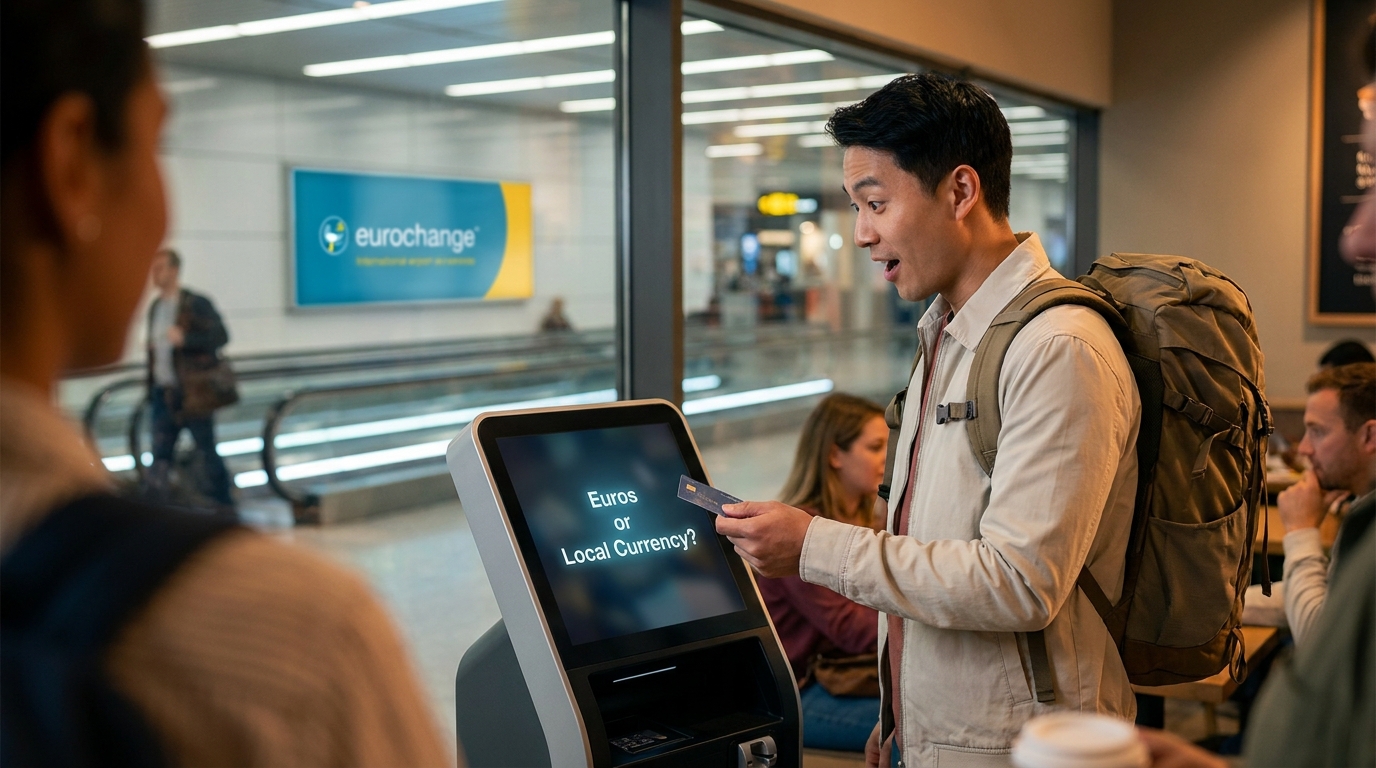
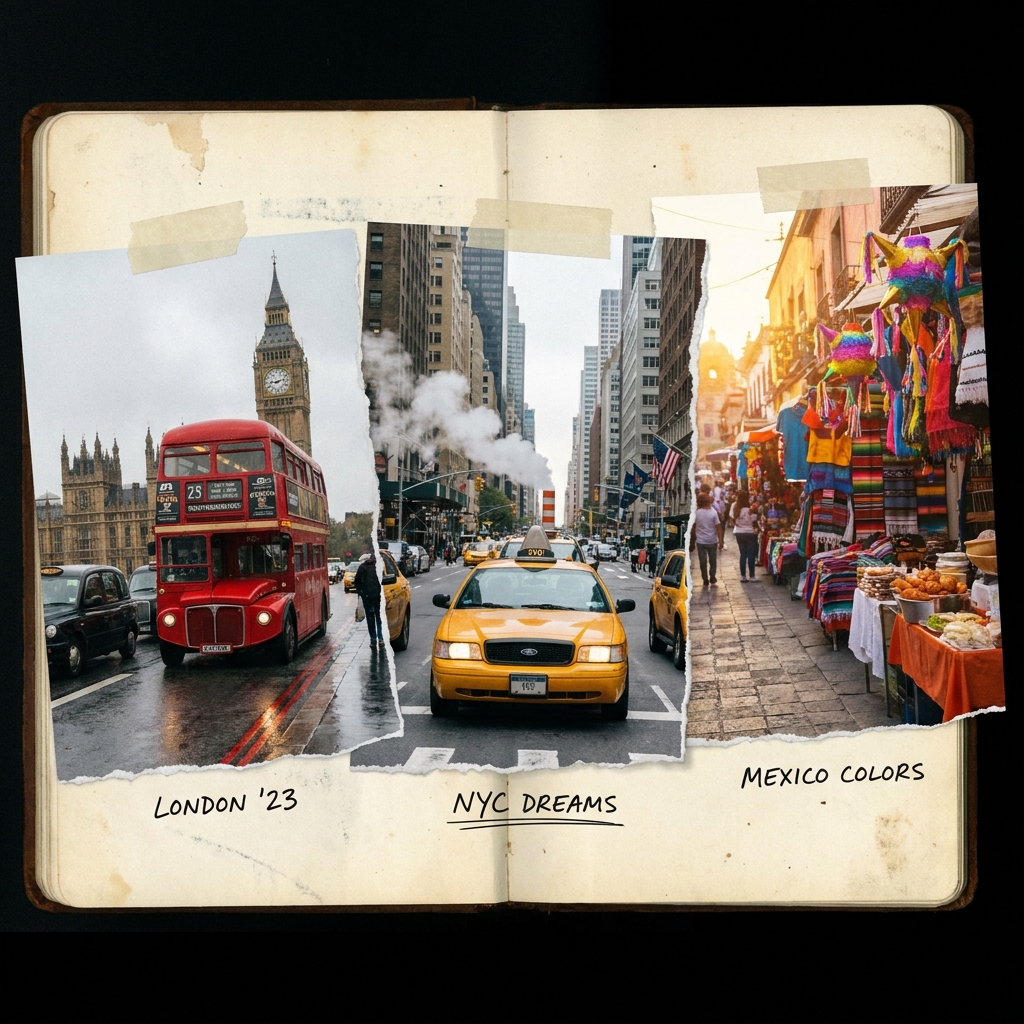
Traveling to a country with a different currency is always an exciting adventure. Whether strolling through the vibrant streets of London, being dazzled by the lights of New York, or enjoying the gastronomy of Mexico, preparation is key. However, there is a small detail that many travelers overlook, which can make their trip significantly more expensive: paying at international card machines.
As experts in money exchange, at Eurochange we want to reveal one of the best-kept secrets to protect your travel budget: the “card machine trick.” Throughout this article, we will explain why you should always choose the local currency when paying and how to manage your money to fully enjoy your experience.
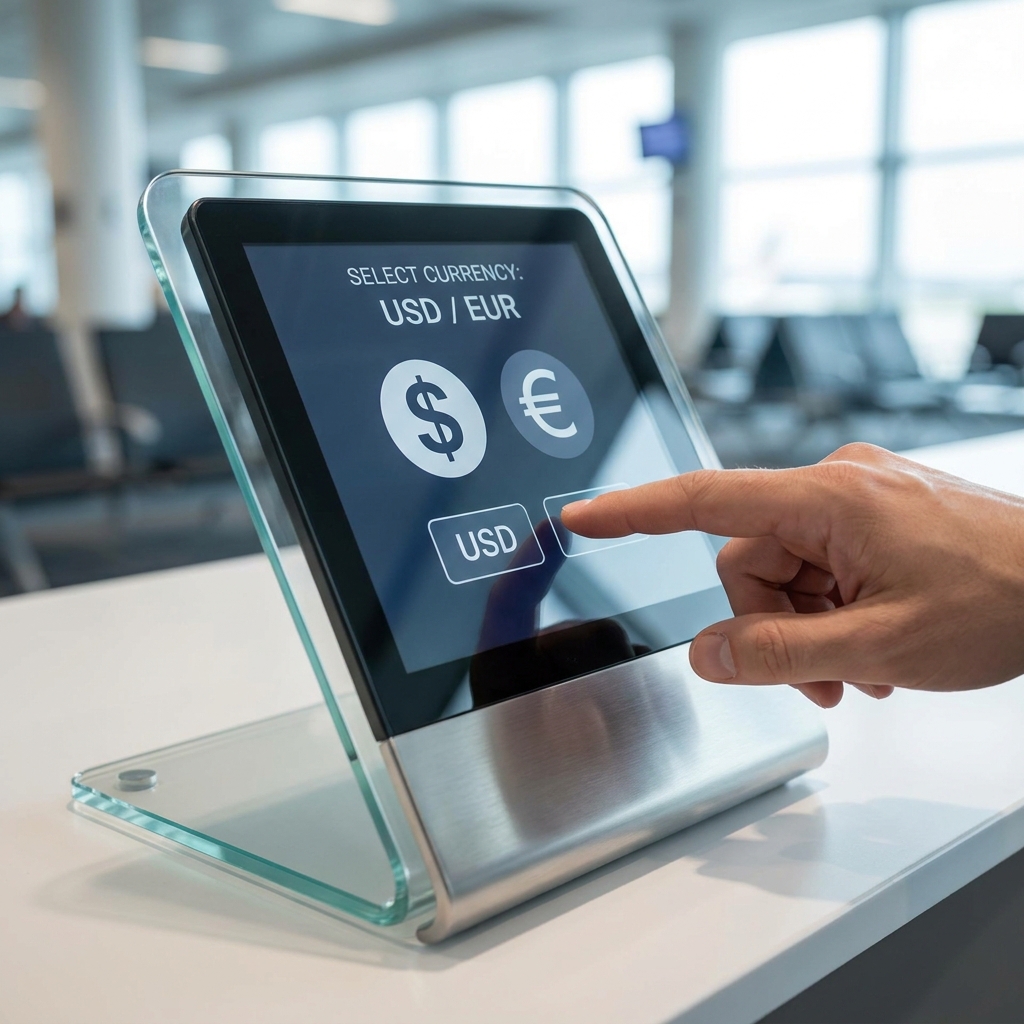
Imagine you are at a restaurant in London (using pounds), a store in New York (dollars), or buying crafts in Colombia (pesos). When you go to pay with your card, the terminal asks a seemingly harmless question: Would you like to pay in Euros or in the local currency?
Intuition tells you to choose Euros so you know exactly how much you’ll be charged. Huge mistake!
If you choose to pay in your home currency, you are accepting Dynamic Currency Conversion (DCC). This means the merchant’s bank (not yours) sets the exchange rate. They typically apply a terrible exchange rate and add hidden fees that can increase your purchase price by up to 10%. The golden rule is absolute: always choose to pay in the local currency of your destination.
United Kingdom (Pounds): If you visit London, public transport can be paid by card, but it’s vital to have cash for street markets like Camden or Portobello.
United States (Dollars): Tipping (15% to 20%) is culturally mandatory. While you can tip via card, cash is always more appreciated by service workers.
Latin America (Pesos): In countries like Mexico or Colombia, cash is king. To pay for safe taxis, local tours, or street food, you will need physical banknotes.
While cards are useful, relying on them 100% abroad is risky. Carrying physical currency offers multiple advantages:
Avoid Airport Fees: Airport exchange offices know you are in a rush and apply abusive margins. Bringing money from home saves you from this expense.
Better Exchange Rates: By using a specialized currency exchange service, you ensure fair and transparent rates.
Security and Budget Control: With cash in hand, you are fully aware of what you spend each day, avoiding nasty surprises when checking your bank statement later.
Travel Comfort: In many destinations, small shops, buses, or tour guides do not accept cards. Cash is your only guarantee of not getting stuck.
Leaving money management to the last minute creates stress. Opting for an online exchange before boarding your flight is the smartest decision.
Advantages of Advance Exchange: You guarantee the availability of your currency, especially if traveling to destinations with exotic currencies.
Destination vs. Spain: Exchanging in your home country in advance allows you to compare prices. Exchanging at your destination leaves you at the mercy of local rates, which are often abusive in tourist areas.
Benefits of Eurochange: You can order your money online and receive it comfortably at your doorstep, or pick it up at any of our 40+ branches across Spain.
Secure your flights and accommodation months in advance. This not only guarantees better prices but also allows you to calculate how much pocket money you will need.
Arriving in a foreign country at dawn without local currency can be a problem if you need to pay for transport. Carrying some cash will give you peace of mind from minute one.
Divide your money into different safe places (your wallet, an inner money belt, and carry-on luggage). Never put cash in checked baggage.
Do not flash large wads of cash in public. Keep what you plan to spend that day handy and leave the rest in your accommodation’s safe.
Avoid isolated ATMs on the street at night. If you need to withdraw extra cash (beware of bank fees), do it inside bank branches during the day.
Planning a trip requires excitement, but also a bit of financial strategy. Knowing the card machine trick and always choosing to pay in the local currency will save you headaches and unnecessary fees. At the end of the day, your money should be spent on enjoying new experiences, not on paying hidden bank fees.
If you are looking for a destination to disconnect from the hectic pace of everyday life, a spiritual retreat in Bali (Indonesia) or Thailand is the perfect answer. With our “Yoga and Disconnection” campaign launching this May 1, 2026, perfectly timed for the beautiful dry season, we want to join you on this transformative journey. Preparing a trip to Asia requires deep planning: from choosing the perfect beach for meditation to understanding how currency exchange works. At Eurochange, we want your only focus to be achieving wellness, while we ensure you carry your money safely and efficiently.

There are no direct flights to Southeast Asia from Spain (mainly Madrid or Barcelona), so you will have at least one layover.
Flying to Bali (Denpasar Airport – DPS): The best options are Qatar Airways (layover in Doha), Emirates (layover in Dubai), or KLM (layover in Amsterdam).
Flying to Thailand (Bangkok – BKK or Chiang Mai – CNX): Excellent choices include Turkish Airlines (layover in Istanbul), Qatar Airways, or Etihad Airways.
Choosing the right location is vital to guarantee true disconnection:
In Bali:
Ubud: The spiritual and yoga capital. Ideal for staying in boutique resorts surrounded by jungles and rice terraces.
Canggu: Perfect if you want to combine yoga with surfing and a more modern, bohemian vibe.
Uluwatu: For a luxury retreat on cliffs with breathtaking ocean views.
In Thailand:
Chiang Mai: The mountainous northern haven, famous for Buddhist retreats and nature-surrounded monasteries.
Koh Samui: An island featuring top-tier wellness resorts, perfect for detox and yoga retreats.
Koh Phangan (West Coast): Away from the party zones, the west side is a global sanctuary for yoga schools.
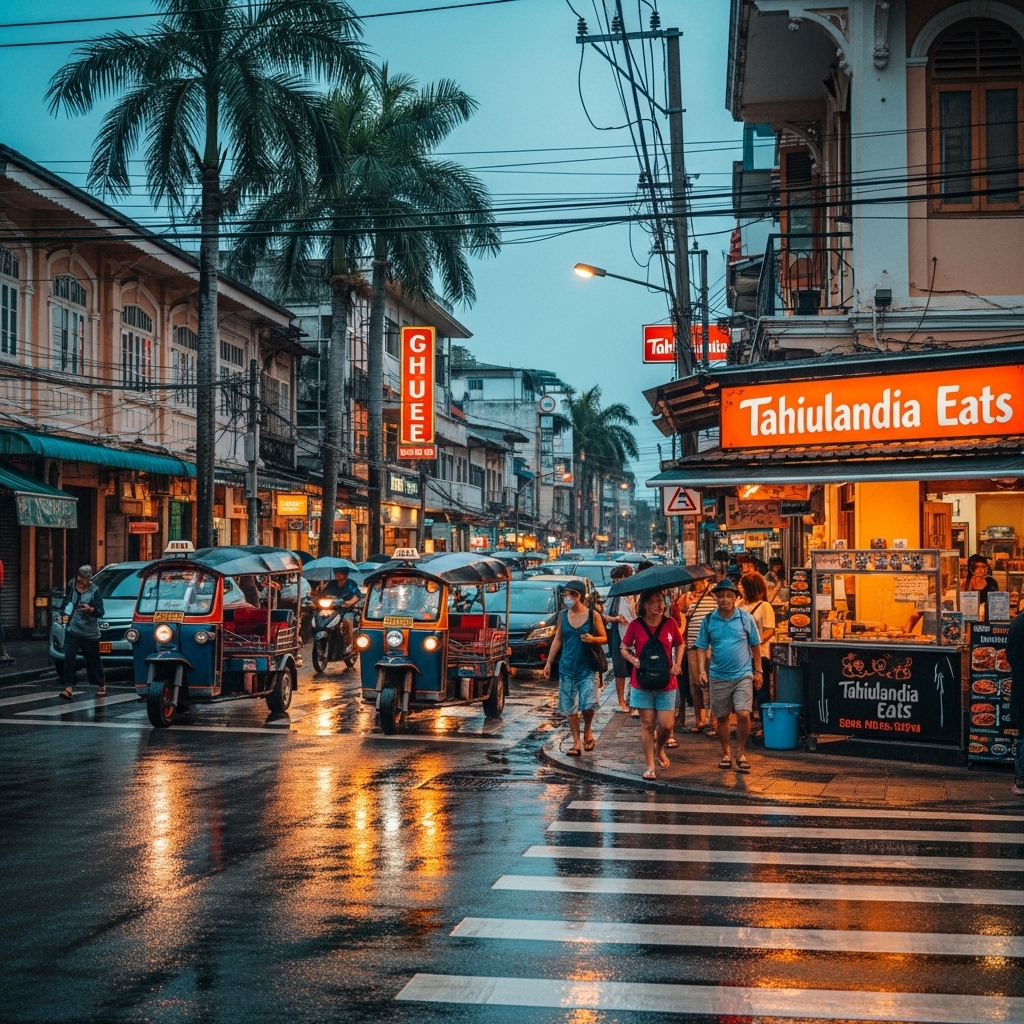
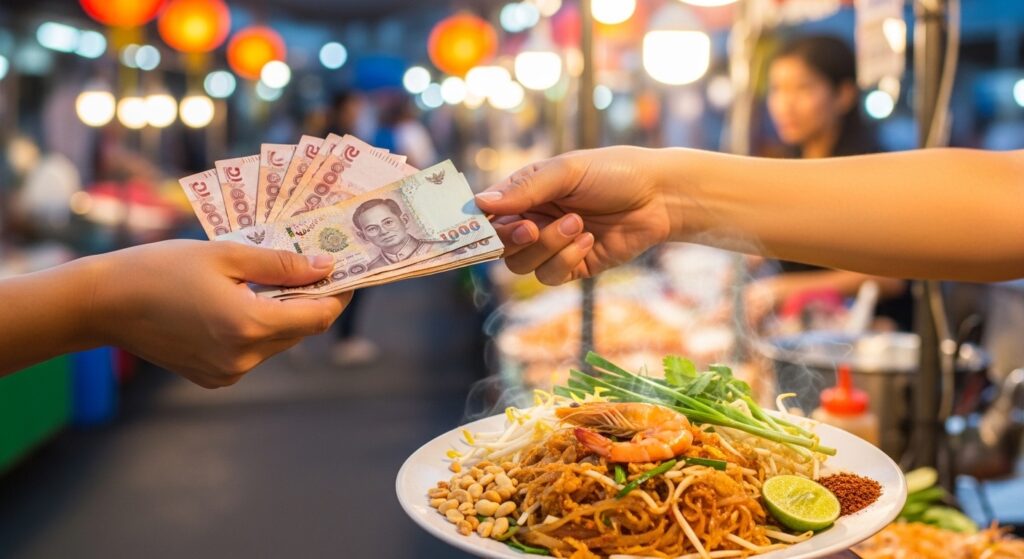
Asian food is a healing experience in itself.
Bali: You must try Nasi Goreng (traditional fried rice) and Gado-Gado (salad with peanut sauce). For the most authentic and affordable experience, eat at Warungs (small family-owned restaurants). Ubud is also packed with high-quality vegan and raw food cafes.
Thailand: Don’t leave without tasting Khao Soi in Chiang Mai (curry noodle soup) or classic Pad Thai. The best culinary experience is at the street food markets, where you’ll eat spectacular dishes for just a few Baht. You will also find high-end dining options in Bangkok to treat yourself.

If your idea of relaxation includes the sea, here are the best options ranked by tourist crowds:
Beaches in Bali:
Kuta Beach: Very crowded, great for learning to surf, but not for seeking peace.
Seminyak: Lively, with beach clubs and spectacular sunsets.
Nusa Dua: Quieter, oriented towards luxury resorts and families.
Sanur: Relaxed atmosphere, calm waters, ideal for sunrise walks.
Amed (Least visited): Black volcanic sand, absolute peace, and a paradise for snorkeling and meditation.
Beaches in Thailand:
Patong (Phuket): The busiest, full of activity and commerce.
Ao Nang (Krabi): A hub for island hopping, quite visited.
Railay Beach: Accessible only by boat, flanked by limestone cliffs. Beautiful but popular.
Koh Yao Yai: An island halfway between Phuket and Krabi, very quiet and uncrowded.
Koh Lipe (Least visited): Known as the Maldives of Thailand. Crystal clear waters, white sand, and unparalleled serenity.
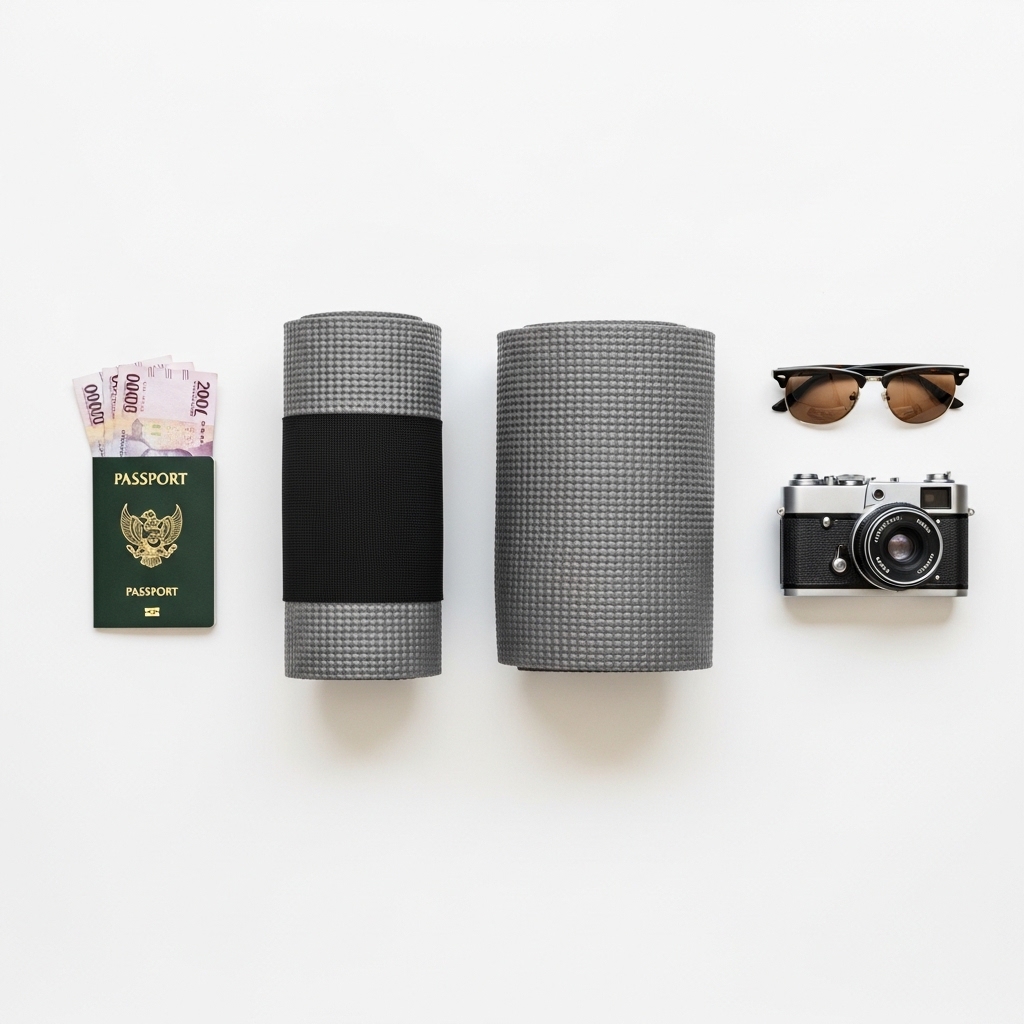
While cards are useful, cash is king in Southeast Asia, especially to pay in Warungs, local transport, or street markets.
Avoid commissions: Exchanging upon arrival at Asian airports usually involves hidden fees and poor money exchange rates.
Security and control: Carrying your budget already converted into Rupiahs or Bahts helps you avoid overspending and prevents fraud at ATMs, which frequently break down.
Why exchange currency before traveling
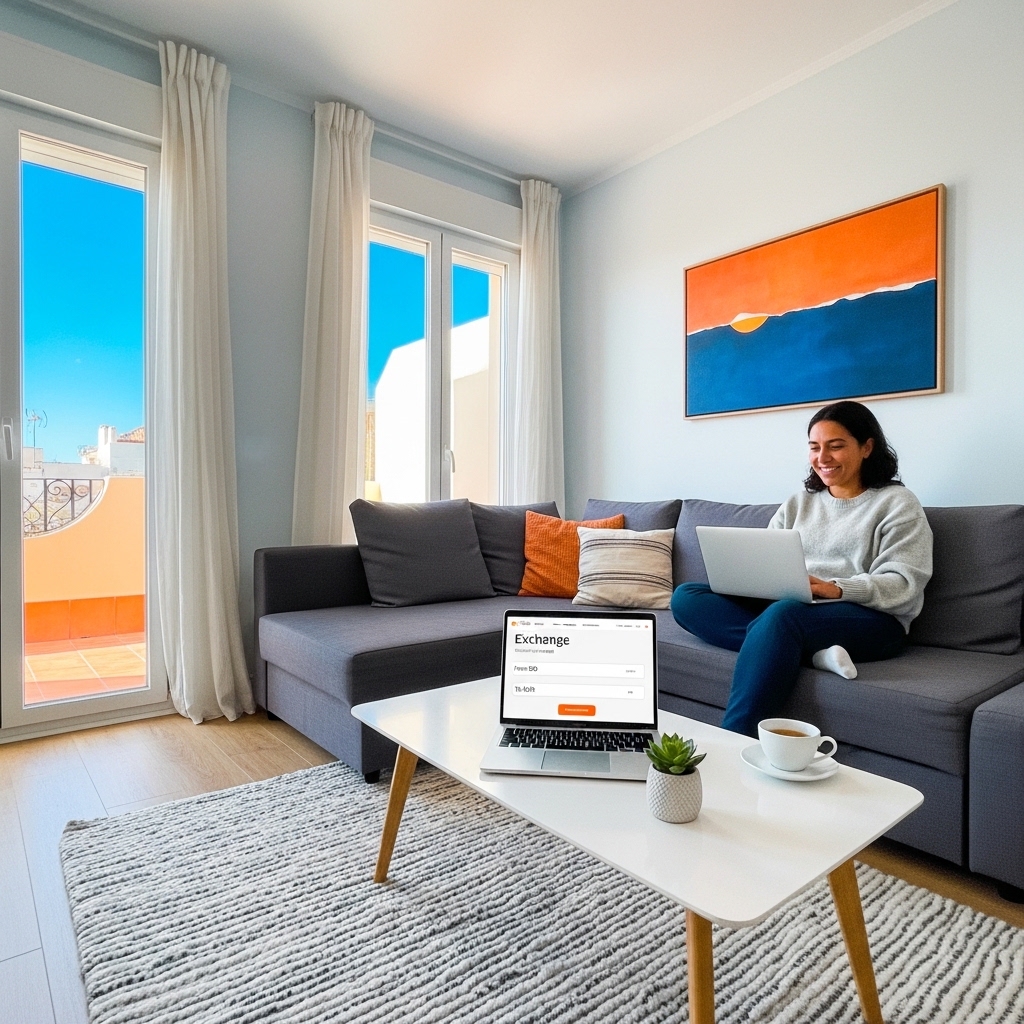
Exchanging before boarding makes a massive difference. In Spain, with Eurochange, you can buy online and receive your Indonesian Rupiahs (IDR) or Thai Bahts (THB) directly at your door. If you prefer, pick them up at any of our 40+ branches.
| Destination | Official Currency | Top Accommodation | Quiet Beach |
|---|---|---|---|
| Bali (Indonesia) | Rupiah (IDR) | Ubud | Amed |
| Thailand | Baht (THB) | Chiang Mai | Koh Lipe |
Planning an Asian retreat is the first step toward connecting with yourself. Organize your flights, pick your ideal beach, and secure your budget from home so nothing disturbs your zen state.
Necessary
| Cookie | Dominio | Descripción | Duración |
|---|---|---|---|
| PHPSESSID | eurochange.es | Esta cookie es nativa de las aplicaciones PHP. Se utiliza para almacenar e identificar el ID de sesión único de un usuario con el fin de gestionar su sesión en el sitio web. Es una cookie de sesión y se elimina al cerrar todas las ventanas del navegador. | Sesión |
| LS_CSRF_TOKEN | salesiq.zoho.eu | Cloudflare configura esta cookie para rastrear la actividad de los usuarios en varios sitios web. Caduca al cerrar el navegador. | Sesión |
| LS_CSRF_TOKEN | salesiq.zohopublic.eu | Cloudflare configura esta cookie para rastrear la actividad de los usuarios en varios sitios web. Caduca al cerrar el navegador. | Sesión |
| rc::a | google.com | El servicio recaptcha de Google establece esta cookie para identificar bots y proteger el sitio web contra ataques de spam maliciosos. | Nunca |
| rc::c | google.com | El servicio recaptcha de Google establece esta cookie para identificar bots y proteger el sitio web contra ataques de spam maliciosos. | Sesión |
| zalb_* | crm.zohopublic.eu | Zoho configura esta cookie para equilibrar la carga y garantizar la permanencia de la sesión. Garantiza que las solicitudes de los usuarios se dirijan siempre al mismo servidor durante una sesión, lo que ayuda a mantener la integridad de la sesión y a mejorar el rendimiento del sitio web. | Sesión |
| zalb_* | salesiq.zoho.eu | Zoho configura esta cookie para equilibrar la carga y garantizar la permanencia de la sesión. Garantiza que las solicitudes de los usuarios se dirijan siempre al mismo servidor durante una sesión, lo que ayuda a mantener la integridad de la sesión y a mejorar el rendimiento del sitio web. | Sesión |
| zalb_* | salesiq.zohopublic.eu | Zoho configura esta cookie para equilibrar la carga y garantizar la permanencia de la sesión. Garantiza que las solicitudes de los usuarios se dirijan siempre al mismo servidor durante una sesión, lo que ayuda a mantener la integridad de la sesión y a mejorar el rendimiento del sitio web. | Sesión |
Preferences
| Cookie | Dominio | Descripción | Duración |
|---|---|---|---|
| uesign | salesiq.zohopublic.eu | Zoho establece esta cookie para el chat en vivo de visitantes. | 1 mes |
Statistics
| Cookie | Dominio | Descripción | Duración |
|---|---|---|---|
| drscc | eu1-files.zohopublic.eu | Sesión | |
| eurochange-_zldp | .eurochange.es | 1 año 1 mes 4 días | |
| eurochange-_zldt | .eurochange.es | 1 día |
Marketing
| Cookie | Dominio | Descripción | Duración |
|---|---|---|---|
| siqlsdb | eurochange.es | Zoho utiliza esta cookie para generar un identificador único para la sesión. Esto permite que el sitio web obtenga datos sobre el comportamiento de los visitantes con fines estadísticos. | Nunca |
| utsdb | eurochange.es | Zoho SalesIQ establece esta cookie para registrar datos sobre el comportamiento del visitante en el sitio web. | Nunca |

