


Hungarian forint exchange rate
WE SELL RATE HISTORY OF HUNGARIAN FORINT
WE BUY RATE HISTORY OF HUNGARIAN FORINT
HUNGARIAN FLORINT INFO
The Hungarian Forint is the official currency of Hungary.
Notes: 500, 1000, 10000, 20000 florint
Coins: 5, 10, 20, 50, 100, 200 florint
Subunit: fillér
Code: HUF
Symbol: Ft
Main Exchanges
If you are going to visit Budapest or any other city of Hungary you will need to exchange your Euros to Hungarian Forint. In Eurochange you can buy your Hungarian Forints at the best price and with total availability. Buy them now online or find the nearest exchange office with the service to buy currencies.
About the Hungarian Forint
The Hungarian Forint is the official currency of Hungary. Its ISO 4217 code is HUF and its symbol is Ft. A Forint is divided into 100 filleres, although the cents were withdrawn in 1996. At present the smallest coin is that of 5 Forint.
History of the currency of Hungary
From 1867 to 1918 the currency of the Austro-Hungarian Empire (of which Hungary was part) was the Austro-Hungarian Krone. After the First World War with the dissolution of the Empire, a new currency, the Pengö, was introduced in Hungary.
This currency was in circulation until after the Second World War. After the conflict, the Pengö suffered hyperinflation and was revalued several times. Higher-value notes were issued more and more, becoming the biggest one in circulation of one hundred thousand trillion Pengö.
In July 1946 the Pengö was abandoned to start using the Forint (the same as we know today).
Hungary entered the European Union in 2004 and it is expected that in the not too distant future the Forint will be left to join the common currency, but that date has not yet been determined.
Banknotes and coins of Hungarian Forint
The Hungarian Forint notes are 500, 1,000, 2,000, 5,000, 10,000 and 20,000 Forints. Hungarian Forint has lived a renewal proccess. Since 2019 all old notes have been withdrawn. Nowadays only the new series of banknotes are legal tender.
HUNGARIAN FORINT NOTES IN CIRCULATION
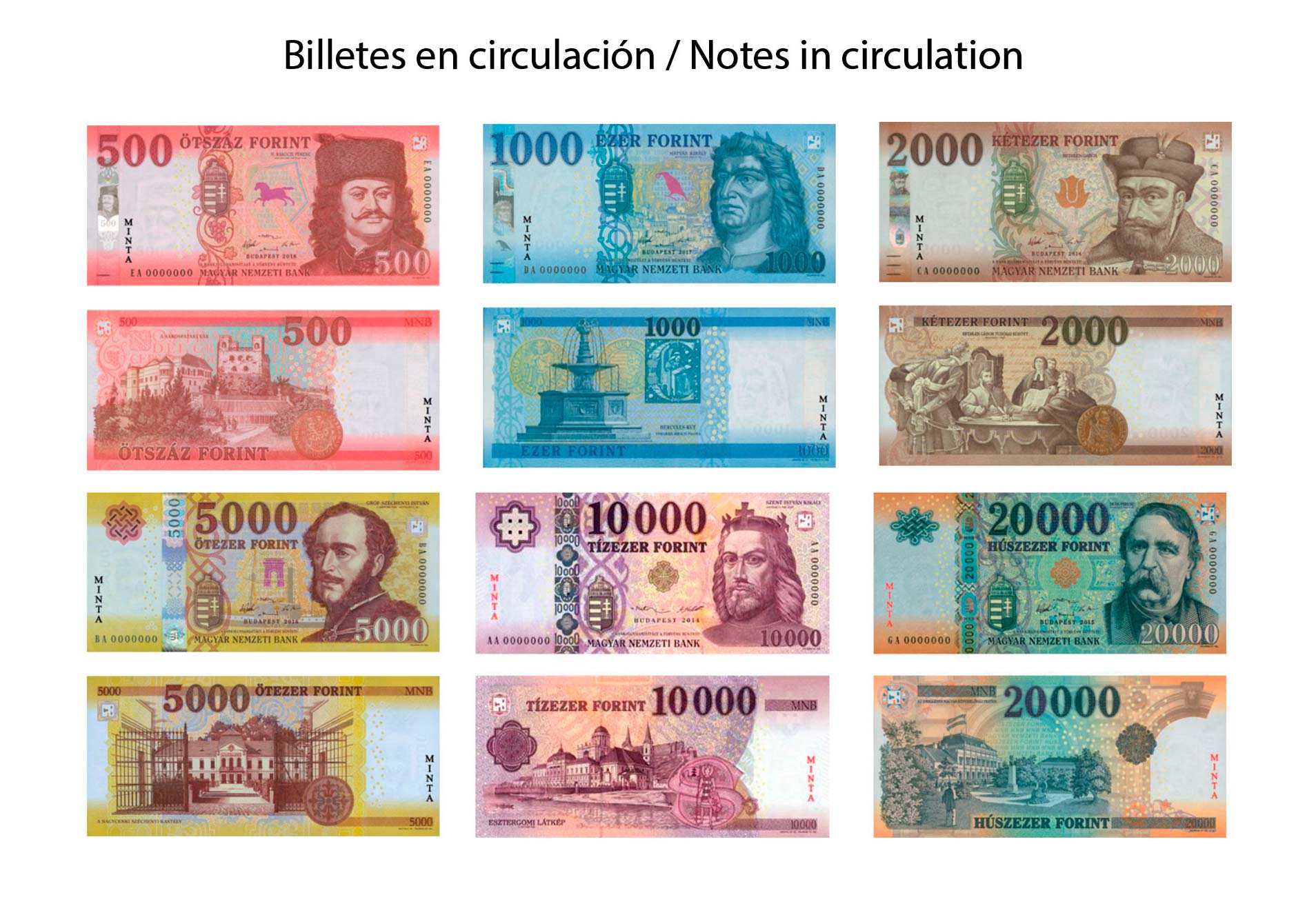
Although the notes have been renewed, the elements that make up their designs have been maintained, but the security measures have been updated.
On the obverse of the banknotes appear different historical figures belonging to the Hungarian royalty and nobility: Ferenc Rákóczi II (leader of the Hungarian independence war of the 18th century) on the 500 note, King Matthias I on the 1,000 note, Prince Gabriel Bethlen in the 2,000’s, Count István Széchenyi in the 5,000 one, King Stephen I (the first King of Hungary) in the 10,000 note and Ferenc Deák (Hungarian Minister of Justice) in the 20,000 Forint note.
On the reverse there are emblematic places of the country: the fortress of Sárospatak, the Fountain of Hercules located in the Royal Palace of Visegrád, an image of Prince Gabriel surrounded by scholars drawn from a painting, the Széchenyi Palace in Nagycenk, the Castle of Esztergom and the building of the old Hungarian Parliament.
The Hungarian Forint coins are 5, 10, 20, 50, 100 and 200 Forints. The denomination appears on one side of the coins. On the other side, different representations appear: a white egret, the coat of arms, a Hungarian iris, a saker falcon and a chain bridge.
Tips to travel to Hungary
In our blog you can find some tips to know more about Budapest. If you are going to trip to the Hungarian capital, come in and discover what to eat, what to visit and what to do to make your experience unforgettable.
How many Hungarian Forints do I need to travel to Hungary?
If you have doubts about how much money to take to Hungary, we are the ones who can help you. Eurochange customers usually exchange around 300 Euros in Hungarian Forints. In order to make an approximate calculation of the money you need for your trip you should take into account whether once you arrive in your destination, you have to pay for hotels, rental cars or excursions, or you will simply have the most common day-to-day expenses such as food, public transport or shopping.
Look for the closest office with this currency